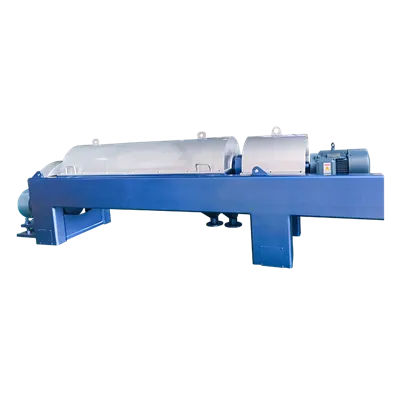
Hey there! I’m a supplier of decanter centrifuges, and today I wanna talk about one of the most crucial components in these machines: the scroll. You might be wondering, "What on earth does the scroll do in a decanter centrifuge?" Well, stick around, and I’ll break it down for you. Decanter Centrifuge

First off, let’s understand the basic concept of what a decanter centrifuge is. It’s a piece of equipment used for separating solids from liquids in a mixture. It works by spinning the mixture at high speeds, using centrifugal force to push the heavier solids to the outer edges while the lighter liquid stays closer to the center. And that’s where the scroll comes in real handy.
The main function of the scroll is to convey the separated solids out of the centrifuge. Once the solids have settled on the inner wall of the rotating bowl due to centrifugal force, the scroll, which rotates at a slightly different speed than the bowl, starts its job. This differential speed creates a relative motion between the scroll and the bowl. As the scroll rotates, it acts like a screw conveyor, pushing the compacted solids along the inner wall of the bowl towards the solids discharge port.
Imagine you’re trying to get sand out of a bucket full of water and sand. If you just let it sit, the sand will settle to the bottom. But how do you get it out? You could scoop it out with a spoon, but that would be a slow and inefficient process. That’s where the scroll is like a super – efficient spoon on steroids. It continuously moves the settled sand (our solids in this case) out of the bucket (the centrifuge bowl) so that you can keep the separation process going smoothly.
Another important aspect of the scroll’s function is its role in controlling the cake dryness. The way the scroll is designed and the force it exerts on the solids can affect how much liquid is still left in the separated solids. By adjusting the differential speed between the scroll and the bowl, we can control the retention time of the solids in the centrifuge. If the differential speed is low, the solids will stay in the centrifuge longer, giving more time for the additional liquid to be squeezed out under the centrifugal force, resulting in a drier cake. On the other hand, a higher differential speed will move the solids out faster, but the cake might be wetter.
Let’s talk about the design of the scroll for a bit. The scroll typically has a helical blade, which is crucial for its conveyor – like action. The pitch of the helical blade – that is, the distance between each turn of the helix – can have a big impact on how well the scroll moves the solids. A larger pitch means that the scroll can move more solids per revolution, but it might not be as effective at compacting the solids. A smaller pitch, on the contrary, can provide better compaction but may reduce the throughput of the centrifuge. So, finding the right pitch for a specific application is key.
The material of the scroll also plays a significant role in its functionality. Since it’s constantly in contact with abrasive solids and is subject to high – stress conditions, it needs to be made of a durable material. Common materials used for scrolls include hardened steel, stainless steel, and sometimes even materials with a wear – resistant coating. For example, in applications where the solids are highly abrasive, like in the mining industry, a scroll made of a steel alloy with a special wear – resistant coating might be the best choice. This ensures that the scroll lasts longer and maintains its performance over time.
Now, I wanna touch on the importance of the scroll in different industries. In the wastewater treatment industry, the decanter centrifuge is used to separate sludge from water. The scroll is essential here because it helps to dewater the sludge, making it easier to handle and dispose of. A well – functioning scroll can turn a messy, wet sludge into a drier, more compact cake, reducing the volume of waste and the cost of disposal.
In the food and beverage industry, decanter centrifuges are used for things like separating solids from juice or cream from milk. The scroll in these applications needs to be made of food – grade materials to ensure the safety of the products. It also has to be designed to handle the relatively gentle separation process required for food products, so as not to damage the delicate components. For instance, when separating cream from milk, a scroll with a carefully adjusted pitch can help separate the two components without breaking up the fat globules in the cream.
In the chemical industry, where precise separation is often required, the scroll can be adjusted to optimize the separation of different chemicals or to remove impurities from a solution. The ability to control the cake dryness and the throughput of solids is crucial in chemical processes, as it can affect the quality and efficiency of the final product.
As a decanter centrifuge supplier, I’ve seen firsthand how important the scroll is to the overall performance of the machine. A faulty or poorly designed scroll can lead to all sorts of problems, like reduced separation efficiency, increased wear and tear on the centrifuge, and even breakdowns. That’s why we pay so much attention to the design and quality of the scrolls in our decanter centrifuges.
We offer a range of decanter centrifuges with different scroll designs to meet the specific needs of our customers. Whether you’re in the wastewater treatment, food and beverage, or chemical industry, we can help you find the right centrifuge with the right scroll for your application.
If you’re in the market for a decanter centrifuge or are looking to upgrade your existing one, it’s important to consider the role of the scroll. A good scroll can make a huge difference in the performance and efficiency of your centrifuge. And that’s where we come in. We’re here to help you understand your options and make the best choice for your business.
So, if you have any questions about decanter centrifuges or the role of the scroll, don’t hesitate to reach out. We’re always happy to have a chat and see how we can help you improve your separation processes. Whether it’s about the design, the material, or the performance of the scroll, we’ve got the knowledge and experience to guide you.
In conclusion, the scroll in a decanter centrifuge is not just a simple part; it’s a vital component that plays a key role in the separation process. From conveying solids to controlling cake dryness, its functions are diverse and essential. If you’re interested in learning more about our decanter centrifuges and how they can benefit your business, just get in touch. We’re ready to have a detailed discussion and start a partnership that will bring value to your operations.
Decanter Centrifuge References:
- "Centrifugal Separation Technology" by Paul A. Wakeman and Stephen J. Tarleton
- Industry – specific handbooks on wastewater treatment, food and beverage processing, and chemical engineering.
Lishui Yuanrong Environmental Protection Equipment Co., Ltd.
As one of the most professional decanter centrifuge manufacturers and suppliers in China, we have world-leading production equipment and strong manufacturing capabilities. Please feel free to buy customized decanter centrifuge from our factory. Also, quotation is available.
Address: Lot 6-1, Block 15, Wanyang Zongchuang City, Lishui, Zhejiang, China
E-mail: 361184920@qq.com
WebSite: https://www.yrhdc.com/
