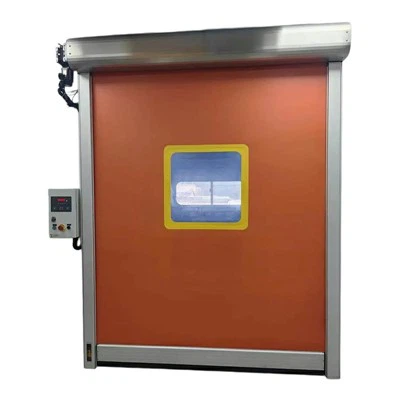
If you’ve ever walked through a busy warehouse, a cold storage facility, or a food processing plant, chances are you’ve passed through a fast roll-up door without even noticing it. These doors work quietly and constantly, speeding up truck loading times, keeping climate-controlled spaces stable, and keeping debris or pests out—all while taking a beating from constant use, temperature swings, and accidental bumps from forklifts. As a fast roll-up door supplier, the question I get asked most often by customers (and prospective clients) is: How long will this thing actually last? Fast Roll-up Door

It’s not a simple yes-or-no answer. The lifespan of a fast roll-up door isn’t just a number stamped on a spec sheet—it depends on how it’s built, how it’s used, and how you take care of it. Over 12 years in this industry, I’ve seen doors that last 5 years and doors that last 15. The difference isn’t luck—it’s intentional engineering, proper installation, and consistent maintenance. Let me break down what actually determines a fast roll-up door’s lifespan, what you can do to make yours last as long as possible, and why it’s worth investing in quality over the cheapest option.
First, let’s talk about the core components that make a fast roll-up door work, because each of these parts will wear out at different rates. Most low-quality fast doors are built with thin, plastic gears, flimsy aluminum frames, and vinyl fabric that tears in a year or two. Our doors start with 2mm thick marine-grade aluminum side frames—thicker than the 1.2mm frames you’ll find on discount doors—because it resists dents from forklift nicks and doesn’t bend when the wind blows hard. The curtain itself is a big one. We use 1.2mm PVC-coated polyester fabric, tested to resist UV rays (critical for doors used outside) and chemical spills (for food or manufacturing plants). That’s not the flimsy plastic sheet that comes with cheap doors—you can run a pallet jack into ours, and it’ll just have a small scuff, not a full tear.
The motor and control system are often the unsung heroes of a fast roll-up door. A door that goes up and down 500 times a day will put way more stress on its motor than one that only moves a dozen times a week. Cheap door motors use brushed DC motors that wear out in 2-3 years, while industrial-grade fast door motors use brushless AC motors, which last 10,000+ operating hours. Let’s do the math: if a door is used 10 times a day, that’s 3,650 operating hours a year. A brushless motor will last nearly 3 years at that rate, while a brush motor might only last one. But if a door is used 50 times a day (common in busy warehouses), that’s 18,250 operating hours a year—so a brushless motor will last almost 6 years here, and quality control systems add another layer. We use photo-eye sensors that stop the door the second they detect an object in the way, which prevents curtain damage and motor overload. Cheaper doors often rely on limit switches that don’t adjust for wear, so they end up slamming into the top or bottom track every cycle, breaking parts early.
Usage frequency is the single biggest factor that shortens a fast roll-up door’s lifespan, hands down. I had a customer last year who had a discount door installed in a cross-docking warehouse—dock doors that open every time a truck comes and goes, which is 80-100 times a day, 6 days a week. He called us two years later because the curtain had torn in three places, the motor was making a grinding noise, and the track was bent. That’s the reality for high-traffic doors: even the best parts will wear faster when they’re in constant motion. On the flip side, we have a cold storage facility in Minneapolis that uses our door only 15 times a day, for loading frozen food trucks. We installed it in 2016, and it’s still running like new—no major part replacements, just annual maintenance checks. Environment matters too: doors in cold storage facilities, where temperatures drop to -20°C or lower, have to work harder than doors in a dry, mild warehouse. The lubricants on the motor and tracks thicken in extreme cold, so we use specialized cold-resistant parts that don’t wear out as fast there. Doors used in dusty manufacturing plants or near harsh chemicals also see faster wear—dust gets into the motor gears and causes friction, while some chemicals can degrade PVC curtains over time.
Proper installation is another make-or-break point. I can’t tell you how many times I’ve been called out to fix a door that a general contractor or handyman installed incorrectly. If the tracks are misaligned even by a millimeter, the curtain will rub against the side frame every time it opens, causing premature tears or bent tracks. If the motor isn’t mounted level, it will put uneven stress on the gears, leading to failure in months instead of years. We include professional installation with every door we sell, not just because we want to make a profit off installation fees, but because bad installation kills door lifespan. I once had a customer who bought a discount door online and tried to install it himself. The first time he ran it, the curtain got stuck halfway, and the motor burned out instantly. He ended up paying us more to replace the entire door than he would have if he’d bought a quality door with professional installation from the start. It’s a common mistake people make: focusing on the upfront cost instead of the total cost of ownership.
Now, the good news is that a fast roll-up door’s lifespan isn’t set in stone, even if you have a quality door. The biggest thing you can do to extend it is regular maintenance. Most people think maintenance is just something you do when something breaks, but it’s actually preventive care that catches small problems before they become big, expensive ones. For our doors, we recommend a monthly basic check and a full annual service. The monthly check is easy: just make sure there are no objects blocking the tracks, the photo-eye sensors are clear of dust, and the curtain is free of small tears or scuffs. Wipe down the sensors with a soft cloth every few weeks, because dust can make them stop working correctly, leading to accidental damage. The annual service is something we provide as part of our after-sales support, and it includes checking the track alignment, lubricating the motor and gears with specialized industrial grease (not regular household oil, which attracts dust and causes more friction), tightening any loose bolts, and testing the safety features. Last year, a customer called us because his door was making a funny noise. Our technician did an annual check and found that one of the track bolts was loose and a small amount of grease had dried up. Tightening the bolts and adding a dab of grease fixed the noise, and we avoided a potential track bend or motor failure.
Even with the best care, parts will eventually need to be replaced, and that’s normal. A well-maintained quality fast roll-up door will last 10-15 years, sometimes longer, while a discount door will be lucky to hit 5. I’ve had customers replace the curtain on our doors after 10 years, just because they wanted a new color or the fabric had faded, but the motor and track were still working perfectly. That’s the value of building a door to last—you don’t have to replace the entire unit every few years, which saves you thousands of dollars in the long run.
I know when you’re outfitting a new warehouse or replacing old doors, it’s tempting to go with the cheapest option. But think about the downtime you’ll lose if your door breaks in the middle of a busy shift. If a dock door is down for 8 hours, that’s 8 hours of loading trucks you can’t do, which means lost revenue. A quality door might cost 20% more upfront, but it will save you in maintenance, replacement costs, and downtime. That’s why I always tell prospective customers to ask two questions when shopping for a fast roll-up door: What’s the operating hour rating on the motor, and what kind of warranty comes with it. A good motor will have a 5-year warranty, and a quality door company will offer at least a 2-year full warranty on parts and labor. If a company only offers a 6-month warranty, that’s a red flag.
At the end of the day, the lifespan of a fast roll-up door is a reflection of how it’s built, used, and cared for. I’ve spent my career building doors that work as hard as our customers do, because I know that when a door runs smoothly, their business runs smoothly too. If you’re in the market for a new fast roll-up door, or you want to extend the life of the one you already have, I’d love to chat through your specific needs—whether you have a high-traffic cross-dock, a cold storage facility, or a food processing plant with strict sanitation requirements. There’s no one-size-fits-all answer, and I’ll help you find the right door that will last for years to come.
If you have questions about fast roll-up door lifespan, need a custom quote, or want to discuss maintenance plans for your existing doors, feel free to reach out to our team to connect and start the conversation.
Fast Roll-up Door References:
- Industrial Door Manufacturers Association. (2022). Best Practices for Fast Acting Roll-Up Door Design and Lifecycle Management.
- International Association of Refrigerated Warehouses. (2021). Equipment Durability Guidelines for Cold Storage Facility Operations.
- National Safety Council. (2020). Preventive Maintenance Protocols for Industrial Access Doors to Reduce Downtime and Injury Risk.
- Building and Fire Research Laboratory, National Institute of Standards and Technology. (2019). Performance Characteristics of High-Speed Doors Under High-Frequency Cyclical Loading.
Suzhou Denasi Intelligent Technology Co., Ltd.
As one of the leading fast roll-up door manufacturers and suppliers in China, we warmly welcome you to buy discount fast roll-up door for sale here from our factory. All products are with high quality and competitive price. Contact us for quotation.
Address: No. 898 Jinsheng Road, Jinjiaba, Lili Town, Wujiang District, Suzhou City, Jiangsu Province
E-mail: ChinaDenas@163.com
WebSite: https://www.densiclean.com/
