Hey there, if you’re on the hunt for a 50 GPM sludge dewatering centrifuge—chances are you’re tired of playing Tetris with your facility’s space, or overpaying for a unit that’s way too big for your flow, or worse, cramming a unit into a spot where it breaks because there’s not enough room for ventilation or maintenance. As a centrifuge supplier who’s talked to hundreds of wastewater, municipal, and industrial sludge teams over the last 12 years, the question I get more than any other right now is: “How much space does a 50 GPM sludge dewatering centrifuge actually need?” Industrial Sludge Dewatering Centrifuge
First, let’s cut the jargon. 50 GPM isn’t some random number— that’s gallons per minute of raw thickened sludge going into the centrifuge, right? I’ve seen folks mix that up with “dry solids per hour” or total flow, so let’s lock that in: 50 GPM influent is a mid-sized unit, perfect for small-to-mid municipal plants, food processing plants, or even industrial sites with 20k–50k GPD wastewater loads. I’m not here to sell you a giant machine if you don’t need it, but space is non-negotiable—mess this up, and you’re looking at downtime, extra renovation costs, or even having to return a unit that doesn’t fit.
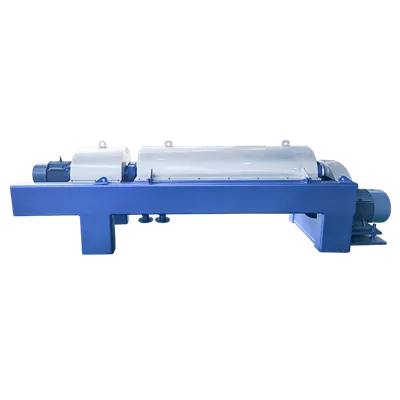
Let’s start with the core: the centrifuge itself. 50 GPM units aren’t tiny. Most horizontal solid-bowl centrifuges (the workhorses for sludge dewatering—we don’t mess with the old disk types anymore) clock in at around 10–12 feet long, 3–4 feet wide, and 4–5 feet tall. Wait, “around” is key. Why? Some manufacturers squeeze extra efficiency into smaller frames, others build in heavier-duty parts for high-solids sludge, so there’s a 1–2 foot variance in length or width. That’s the unit’s footprint, right? But here’s the part no one tells you when they first ask: that’s just the machine. You can’t shove a 10-foot centrifuge up against a wall with zero clearance and call it a day.
Maintenance is the big space driver here. Let’s be real—centrifuges aren’t set-it-and-forget-it. You’ve got to pull the bowl every 6–12 months to clean out grit, check the bearings, replace the scroll, maybe swap out a worn seal. For a 50 GPM unit, that bowl is usually 2.5–3 feet in diameter, and even with a hoist or a portable puller (we sell those as add-ons, by the way), you need enough space to swing that bowl out without hitting walls, pipes, or your next process unit. I always tell folks: leave 4–5 feet of clearance on the discharge end (that’s the side where the dewatered cake and centrate come out) and 3–4 feet on the drive end (the side with the motor and gearbox). That’s non-negotiable. If you skimp here, you’ll be paying a crane to come in and lift half the equipment out just to get to the centrifuge’s internals. I’ve had a client last year who saved 2 feet on the drive end, and when their scroll seized up, they had to remove a 20-foot pipeline that cost them $8k just to get to it. Ouch.
Then there’s ancillary equipment. You can’t run a 50 GPM centrifuge in a vacuum. Let’s list what comes with it, or what you’ll need to add: a feed pump (usually a progressive cavity pump, sized for 50 GPM plus 10% buffer), a polymer make-up system (the thing that mixes and adds flocculant to the sludge—critical for good dewatering), a control panel (either a basic NEMA 4X unit or a PLC for remote monitoring), and for most plants, a cake conveyor or bin to catch the dewatered sludge.
Where do these fit? The polymer system is usually 2–3 feet wide, 4–5 feet tall, so you can set that right next to the feed end—just leave enough hose length to connect it to the sludge line. The feed pump is small, like 2×3 feet, so it can go on the floor right by the feed, or even mounted on a skid above a sump. The control panel? It’s a wall-mount or a small floor unit, 1×2 feet, so it can go anywhere out of the way—no need for extra space there, just make sure it’s not splashed with centrate. The cake handling: if you’re using a small screw conveyor, that’s another 5–6 feet long, so you’ll need to leave space in front of the discharge end for that. If you’re just catching it in a gaylord or bin, that’s 4×4 feet, so add that to the front clearance too.
Wait, what about overhead space? A lot of people forget that. Most 50 GPM centrifuges have a top-mounted hoist eye for pulling the bowl, so you need at least 8–10 feet of headroom above the machine. If your ceiling is only 7 feet, you’ll need to add a ceiling-mounted or free-standing hoist that drops down, but that’s an extra cost and sometimes a hassle. I had a municipal plant in Ohio last year that had a 7.5-foot ceiling, so we recommended a portable puller that sits on the floor instead of a hoist, which worked— but it’s not ideal, and it adds a few minutes to every maintenance job.
Now, let’s talk about layout flexibility. If you’re designing a new building, you can plan for this, but if you’re retrofitting an existing space, you’ve got to work with what you’ve got. Let’s give two real examples from recent jobs: first, a small food processing plant in Georgia. They had a 12×20 foot spare corner next to their wastewater sump. We brought in a 50 GPM centrifuge that’s 10 feet long, 3.5 feet wide, and 4.5 feet tall. They left 4 feet on the discharge end for a gaylord, 3.5 feet on the drive end for the motor access, and fit the polymer system right next to the feed. Total space used: 10 feet long x 8 feet wide, plus 10 feet of overhead. That was perfect for them, and they’ve had no issues with maintenance or downtime.
Second example: a municipal plant in Texas that was retrofitting a 25×30 foot room they used to use for old filter presses. The old presses were huge, so when they took them out, they thought a centrifuge would be tiny. They crammed a 50 GPM unit into a spot that only had 2.5 feet of clearance on the drive end. Six months later, their scroll seized, and they had to rent a mini crane to lift the motor off, which cost them $12k and 3 days of downtime. They ended up expanding the room by 3 feet on that end—added $15k to the project, but it saved them way more in the long run. Lesson learned: don’t cut maintenance clearance to save space, especially if you can’t afford downtime.
Now, what about if you’re working with different sludge types? That changes things a little. If you’re dewatering primary sludge, which is less abrasive, you might be able to go with a slightly smaller 50 GPM unit that only needs 9 feet of length. If you’re dewatering waste activated sludge (WAS), which is more stringy and abrasive, you’ll want a heavier-duty unit with a larger bowl, which is 12 feet long. Oh, and if you’re handling high-solids sludge (over 4% influent), you might need a slightly wider discharge end, so add a foot to the front clearance.
Wait, there’s one more thing people don’t think about: access for deliveries. That 10-foot centrifuge is shipped on a pallet, usually 12 feet long and 4 feet wide, so your loading door or delivery spot needs to be at least 13 feet long and 5 feet wide. If your door is smaller, you might have to unbolt the unit on-site and reassemble it, which adds time and cost. I’ve had a client in Florida whose door was only 10 feet wide, so we had to cut the skid to fit, which added $2k to the job. So make sure to measure your entry points before you order.
Let’s do a quick recap of the minimum and ideal space for a 50 GPM sludge dewatering centrifuge:
Minimum non-negotiable space (for a small, low-maintenance sludge, e.g., primary sludge): 12 feet long x 8 feet wide x 8 feet tall. That’s if you’re okay with squeezing, but I only recommend this for plants that have an on-call maintenance crew that can get to you fast, or don’t do major maintenance in-house.
Ideal space (for most cases, including WAS, which is the most common sludge type): 15 feet long x 10 feet wide x 10 feet tall. This gives you 4 feet on discharge, 3 feet on drive, space for ancillaries, and enough overhead for a standard ceiling hoist. That’s what 90% of our clients go with, and we almost never get callbacks about maintenance issues with that layout.
Wait, what about skid-mounted vs. base-mounted units? Skid-mounted units are pre-built on a single frame with the feed pump, polymer system, and control panel all on one skid. That cuts down on space, because you don’t have separate units scattered. A skid-mounted 50 GPM centrifuge is usually around 12 feet long x 6 feet wide, so you save 2 feet of width. That’s perfect for retrofits where every inch counts. But keep in mind: you still need the same clearance on drive and discharge ends, regardless of whether it’s skid-mounted or not.
Now, let’s bust a common myth: some people think a 50 GPM unit is just a scaled-down version of a 100 GPM unit, so it takes half the space. No way. The biggest variance in space is maintenance clearance, not the unit’s footprint. A 50 GPM centrifuge’s internals aren’t half the size of a 100 GPM’s—they’re almost the same diameter, because the scroll’s capacity depends on the bowl’s diameter, not just its length. So if you have a 100 GPM unit, it’s not twice as big as a 50 GPM one, it’s just longer and has a bigger bowl. That means the maintenance clearance is almost the same for both. So don’t make the mistake of thinking “it’s 50 GPM, so it fits in half the space of a 100 GPM”—that’s a fast track to regret.
Another thing: ventilation. Centrifuges can get hot, especially when running 24/7 for industrial sites or peak plant times. You need to make sure the space has enough airflow to prevent the motor from overheating, and to clear any odors from the sludge. If your space is enclosed, add a vent fan or leave a gap under the door. We always point that out, because we’ve had a few clients whose motors burned out in a year because they ran it in a closed room with no ventilation. That’s an extra consideration, not just space, but it ties into your layout—so don’t cram the unit into a corner with no airflow.
Okay, let’s wrap this up. The space for a 50 GPM sludge dewatering centrifuge isn’t a random number—it depends on your sludge type, whether you’re retrofitting or building new, and how you plan to do maintenance. The core takeaway: forget just the unit’s footprint, focus on the clearance on the drive and discharge ends, add space for ancillaries and overhead access, and don’t cut corners on maintenance space.

If you’re still figuring out your space, or not sure which 50 GPM unit fits your needs, reach out. We work with plants all over to layout their space, tweak their setup to avoid downtime, and get a unit that’s the right size for their flow. No pushy sales, just straight talk about what works for your site.
Oily Sludge Centrifuge Reference
- Water Environment Federation. (2019). Centrifuge Design and Operation for Sludge Dewatering. WEF Manual of Practice No. FD-18.
- United States Environmental Protection Agency. (2021). Industrial Sludge Management: Dewatering Technologies Guide. EPA 832-R-21-004.
- Sludge DeWatering Equipment Manufacturers Association. (2022). Standard Layout Specifications for Solid-Bowl Centrifuges 30–70 GPM. SDEMA Technical Bulletin 07-22.
Lishui Yuanrong Environmental Protection Equipment Co., Ltd.
As one of the most professional industrial sludge dewatering centrifuge manufacturers and suppliers in China, we have world-leading production equipment and strong manufacturing capabilities. Please feel free to buy customized industrial sludge dewatering centrifuge from our factory. Also, quotation is available.
Address: Lot 6-1, Block 15, Wanyang Zongchuang City, Lishui, Zhejiang, China
E-mail: 361184920@qq.com
WebSite: https://www.yrhdc.com/
